Demos

Answers it can stand behind, measured on real tasks

Taught from a few labelled examples, decisio certified which answers could go out with no one checking them. Here are four of those results, then four recorded demos on each of its three models, every decision checked where there was something to check.

Certified answers

Teach it, certify it, automate the sure answers

Four results from the teach-and-certify runs, each on public data and each with its own page section.

Recorded runs

Four demos, played as they ran

Each clip is a recorded run, played at the speed it happened. Every base ran in one session on one NVIDIA RTX PRO 6000 Blackwell Workstation Edition (600 W) on 2026-10-05; each card opens on the default base, Gemma 4 31B, and its numbers are that base's.

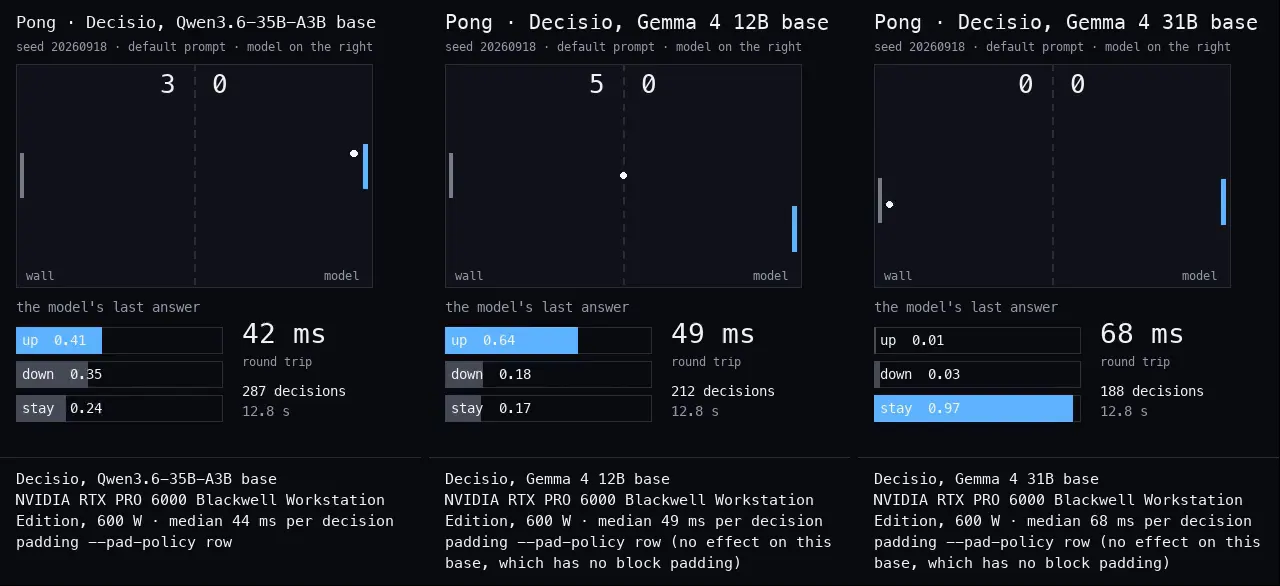
First frame of the recorded run: Pong, the three bases on the same serve (seed 20260918)
Pong, the three bases on the same serve (seed 20260918)

Pong

Every move is checked against a perfect paddle while the ball approaches.

  • 85%agree with the perfect paddle while the ball approaches (95% interval 82 to 88)
  • 84.2returns per game (95% interval 83.0 to 86.6)
  • 68 msper decision, median (95th percentile 69 ms)

Gemma 4 31B, decisio v0.6.0, 2026-10-05

Every base 3 bases
Pong (5 games of up to 45 s, seeds 20260917 to 20260921)
playeragrees with the oracle while the ball approachesdecisions on approachdecisions per secondlatency p50 / p95returns per game
Decisio, Qwen3.6-35B-A3B base60% [53, 65]53122.944 / 4722.8 [12.4, 32.8]
Decisio, Gemma 4 12B base62% [56, 66]53922.848 / 5023.2 [21.2, 24.8]
Decisio, Gemma 4 31B base85% [82, 88]167915.068 / 6984.2 [83.0, 86.6]

A game ends when the model's paddle misses five times; the ball advances one step per decision, so returns per game reward fast answers as much as right ones. Gemma 4 31B played all five games to the 45 s limit, which is why it was asked three times as often as the other bases.

Where it was wrong
Pong: decisio's errors, by kind
demobasedecisions judgedagreelatencyprompt or statenear-tiejudgementwhat the errors are
Pong, ball approachingQwen3.6-35B-A3B5313300 by construction1263126mostly "stay" where the perfect paddle moves down (85 of 201); 21 of the misses turned a return into a lost point
Gemma 4 12B5393320 by construction413190mostly "down" where the perfect paddle moves up (97 of 207); 24 turned a return into a lost point
Gemma 4 31B1,6791,4210 by construction136239mostly "stay" where the perfect paddle moves down (210 of 258); across its misses the ball crosses a median 7 units from the paddle, just outside the 6-unit stay band; none cost a point
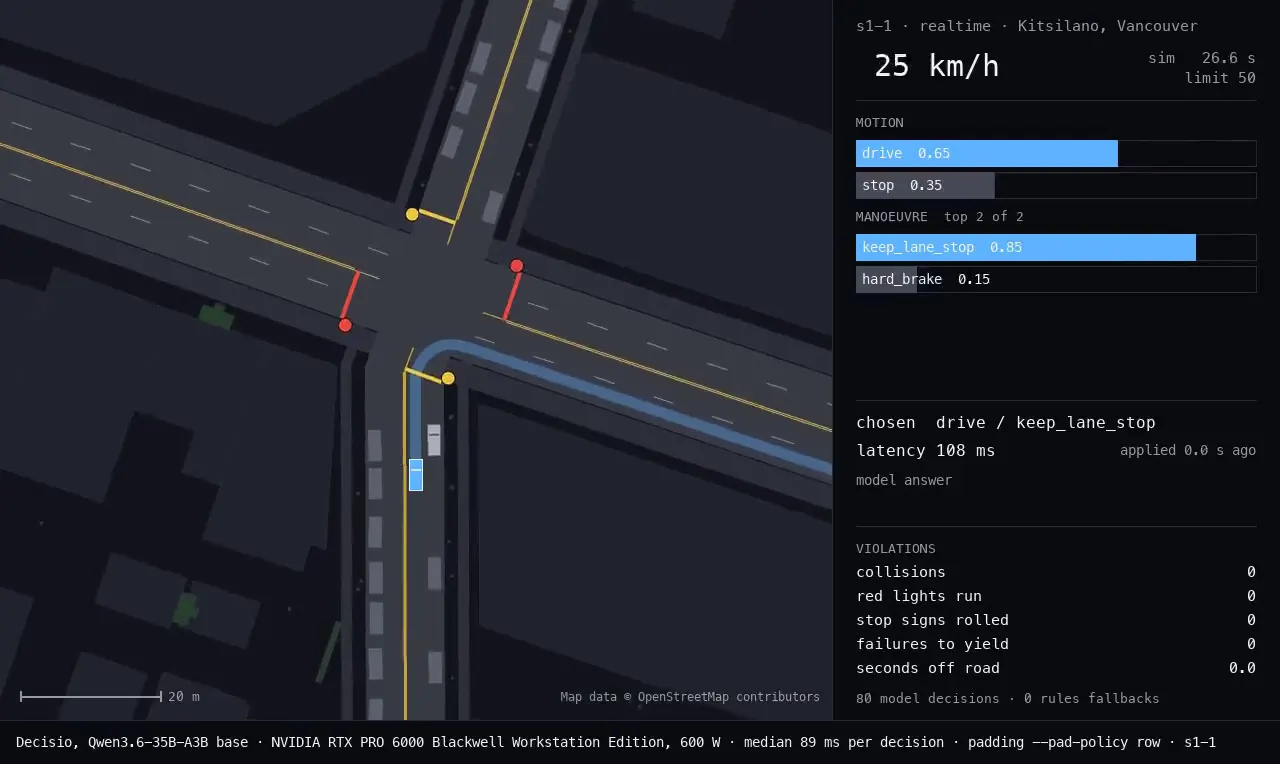
First frame of the recorded run: Driving, one drive in real time (scenario s1-1): Qwen3.6-35B-A3B base
Driving, one drive in real time (scenario s1-1): Qwen3.6-35B-A3B base
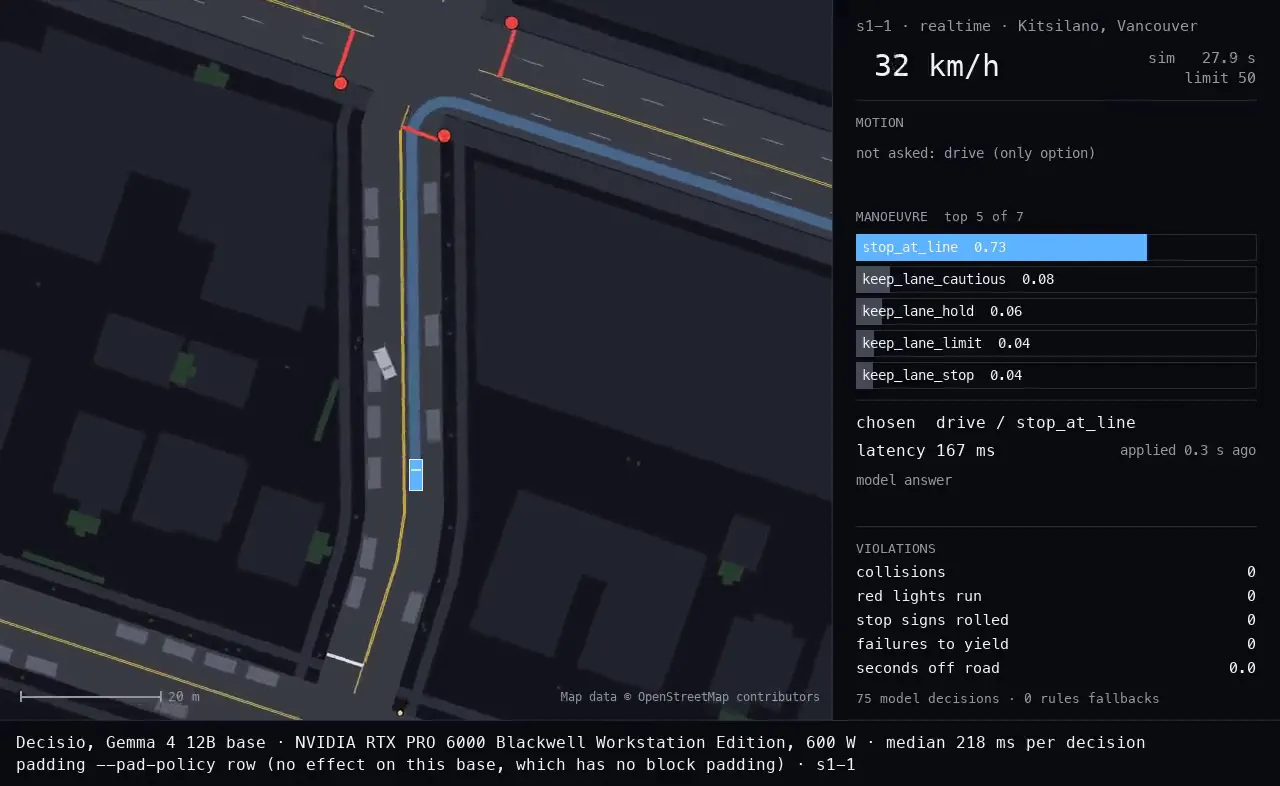
First frame of the recorded run: Driving, one drive in real time (scenario s1-1): Gemma 4 12B base
Driving, one drive in real time (scenario s1-1): Gemma 4 12B base
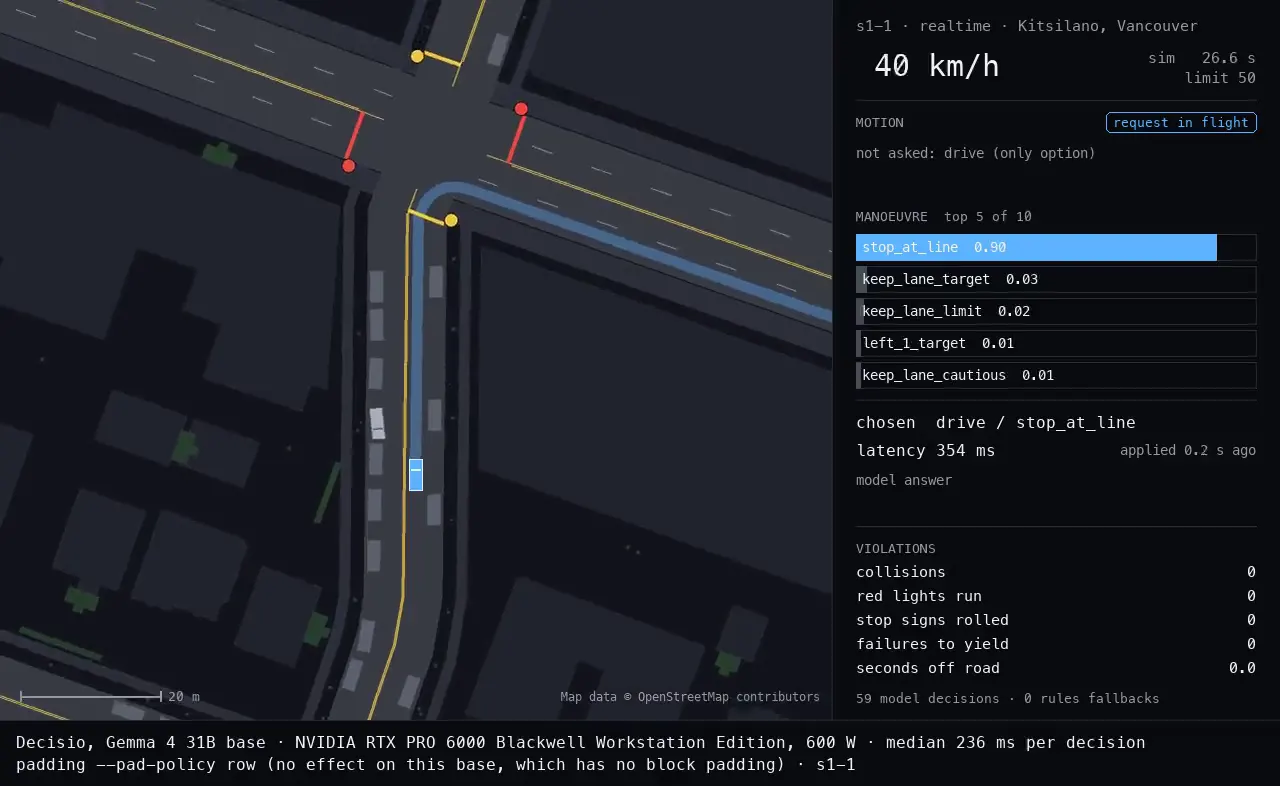
First frame of the recorded run: Driving, one drive in real time (scenario s1-1): Gemma 4 31B base
Driving, one drive in real time (scenario s1-1): Gemma 4 31B base

Driving

Every drive-or-stop is checked against the demo's own rules driver on the same snapshot. Lockstep waits for every answer; in realtime the car keeps moving while it waits.

  • 3 of 3drives passed, in lockstep and in realtime
  • 5motion errors in 568 answers, lockstep
  • 341 msper decision in lockstep, median (95th percentile 569 ms)

Gemma 4 31B, decisio v0.6.0, 2026-10-05

Every base 3 bases
Driving
playerlockstep: drives passedlockstep: motion errors / motion answersrealtime: drives passedrealtime: motion errors / latency effectsdecisions per second (lockstep, realtime)latency p50 / p95 (lockstep)
Decisio, Qwen3.6-35B-A3B base3 of 38 / 5453 of 35 / 27.74, 3.12102 / 158
Decisio, Gemma 4 12B base3 of 325 / 7923 of 36 / 44.01, 2.99218 / 343
Decisio, Gemma 4 31B base3 of 35 / 5683 of 30 / 32.70, 2.37341 / 569

Lockstep waits for every decision, so it measures the decisions alone; realtime keeps the car moving while a request is in flight, as the demo does, so a slow answer arrives too late. Over all of their drives, in lockstep and in realtime:

  • the Qwen base passed 16 of 18 and 9 of 9 (in lockstep one collision in s2-4 and one drive off the road in s2-5; the rules driver alone passes both);
  • Gemma 4 12B passed 18 of 18 and 9 of 9;
  • Gemma 4 31B passed 18 of 18 and 8 of 9 (in realtime a collision in s2-2);
Where it was wrong
Driving: decisio's errors, by kind
demobasedecisions judgedagreelatencyprompt or statenear-tiejudgementwhat the errors are
driving lockstep, motion (18 drives)Qwen3.6-35B-A3B4,1732,934 + 1,207 as worded0131930 of 32 a stop where the rules driver goes
Gemma 4 12B5,0613,927 + 1,108 as worded0125all 26 a stop where the rules driver goes
Gemma 4 31B4,2533,055 + 1,182 as worded001614 of 16 a stop where the rules driver goes
driving realtime, motion (9 drives)Qwen3.6-35B-A3B1,6971,077 + 607 as worded715all 6 a stop where the rules driver goes
Gemma 4 12B2,0871,471 + 598 as worded1206all 6 a stop where the rules driver goes
Gemma 4 31B1,554836 + 702 as worded1213all 4 a stop where the rules driver goes
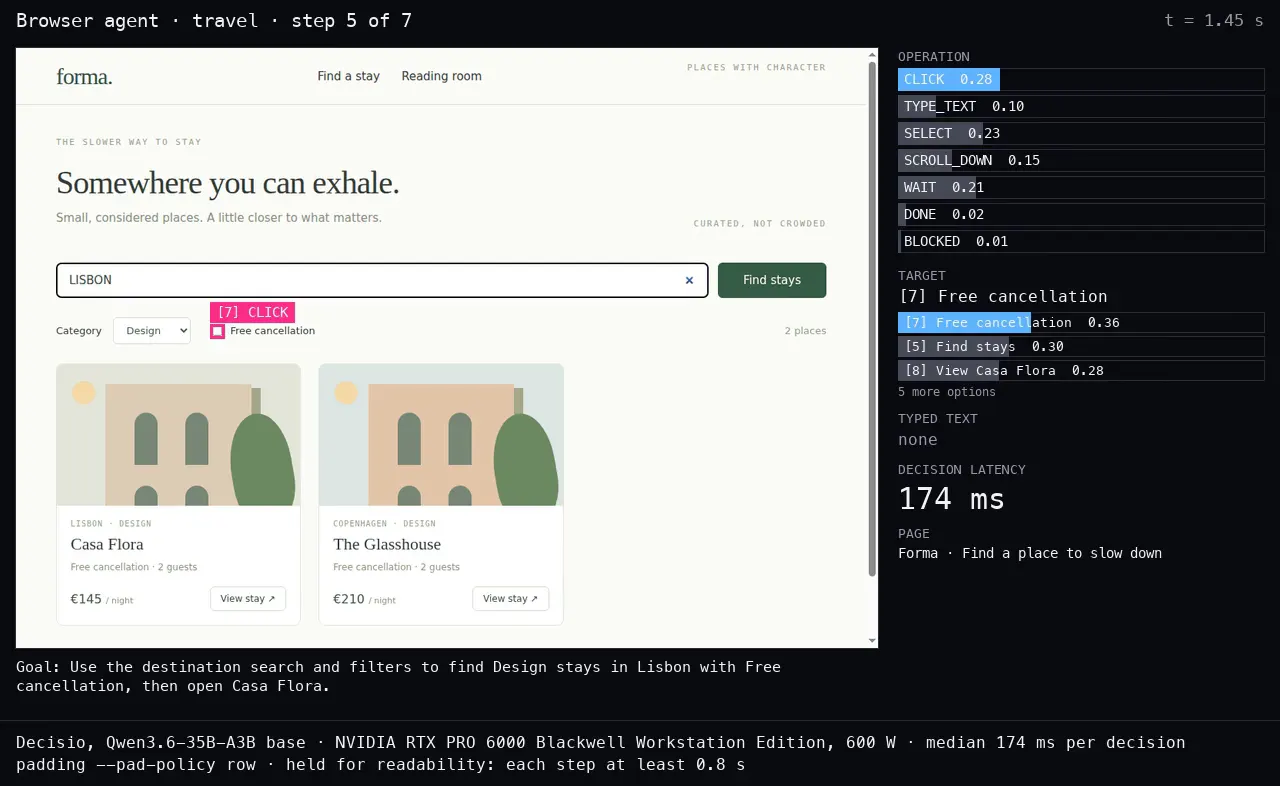
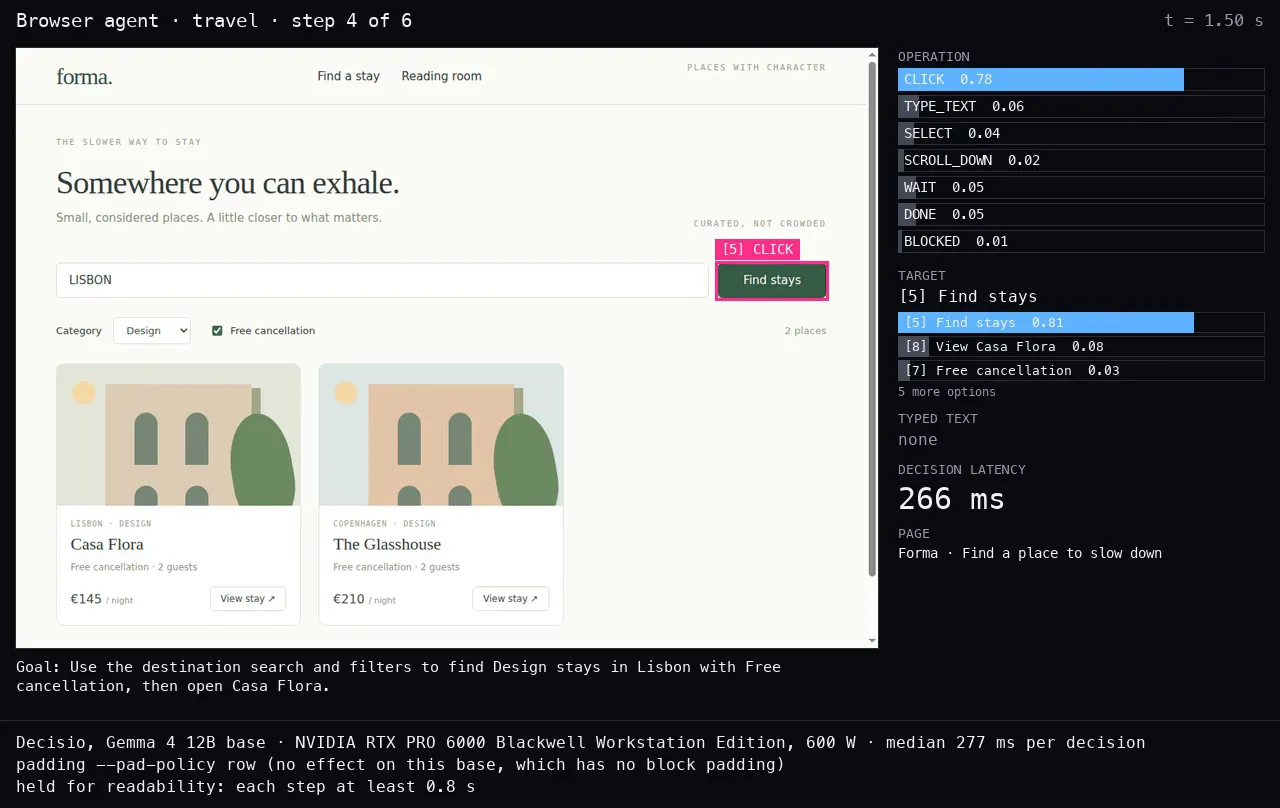
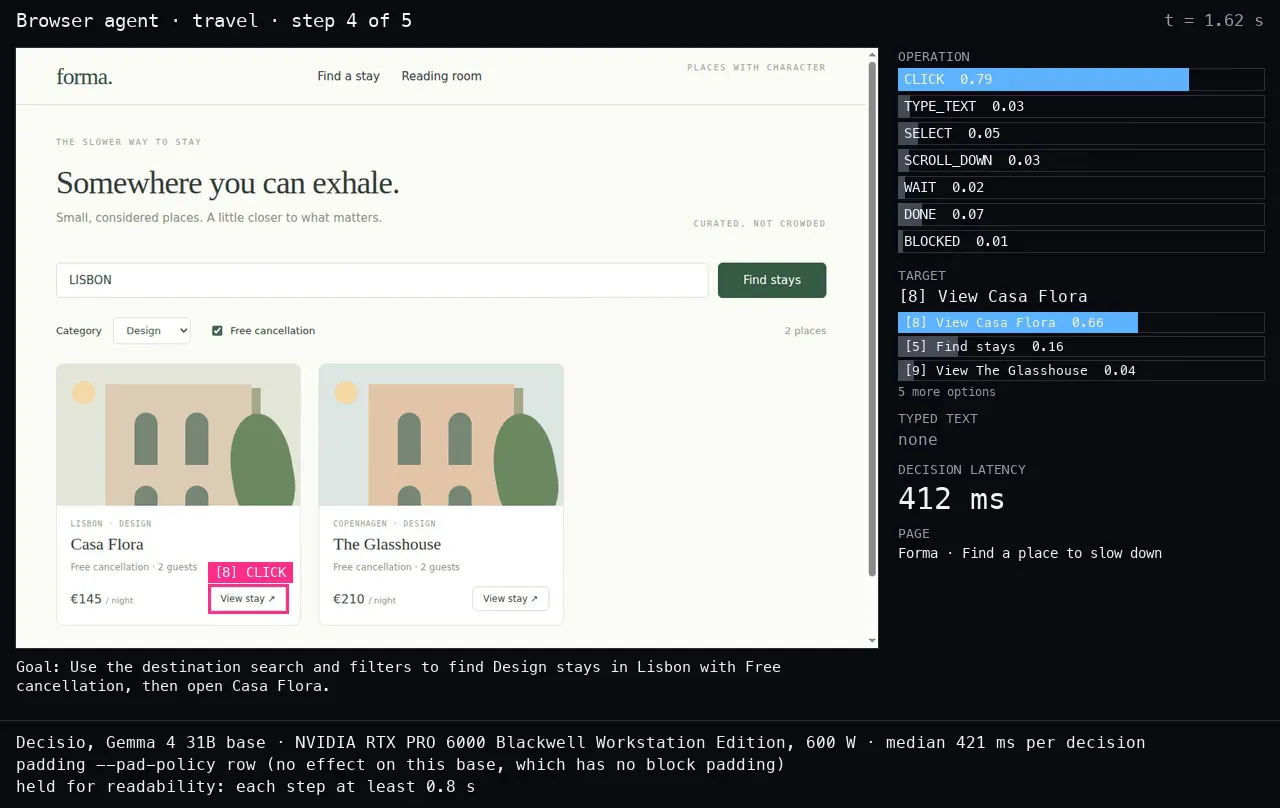
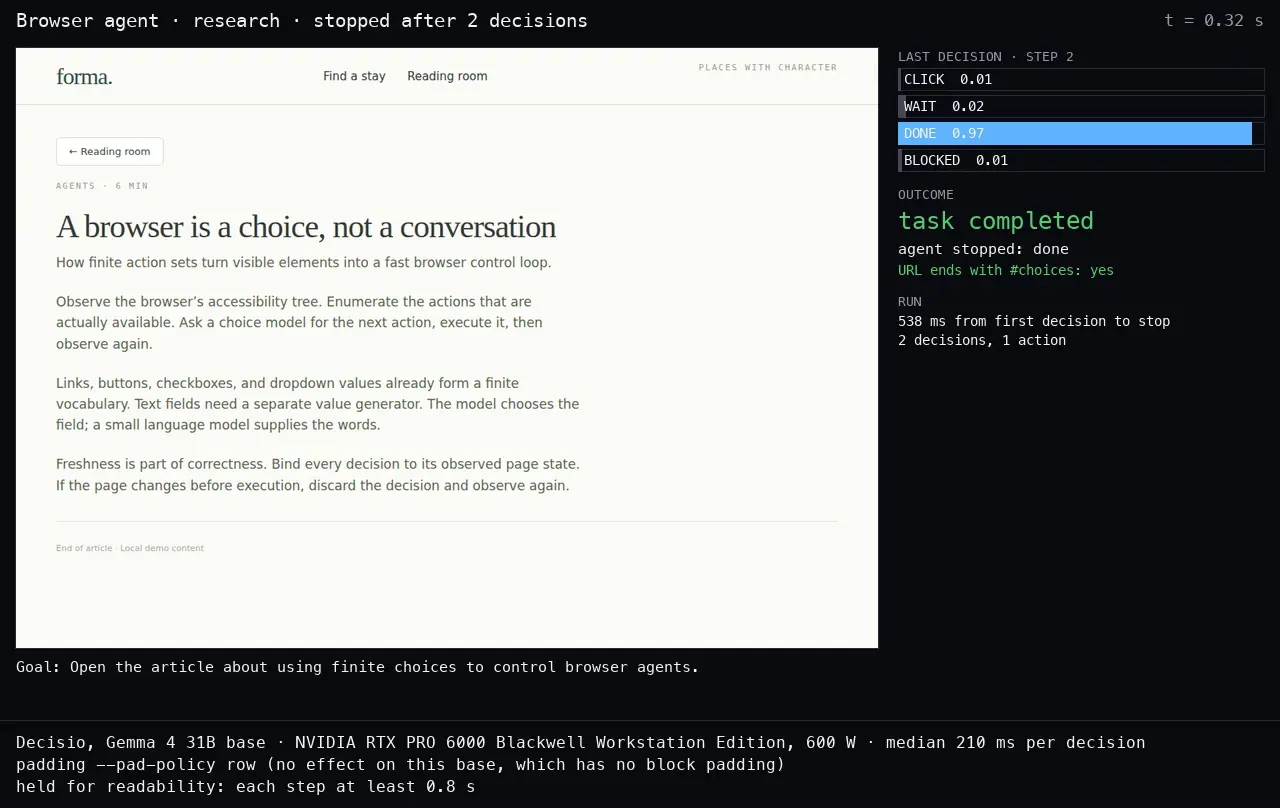
First frame of the recorded run: Browser agent, the travel task: Qwen3.6-35B-A3B base
Browser agent, the travel task: Qwen3.6-35B-A3B base
First frame of the recorded run: Browser agent, the travel task: Gemma 4 12B base
Browser agent, the travel task: Gemma 4 12B base
First frame of the recorded run: Browser agent, the travel task: Gemma 4 31B base
Browser agent, the travel task: Gemma 4 31B base
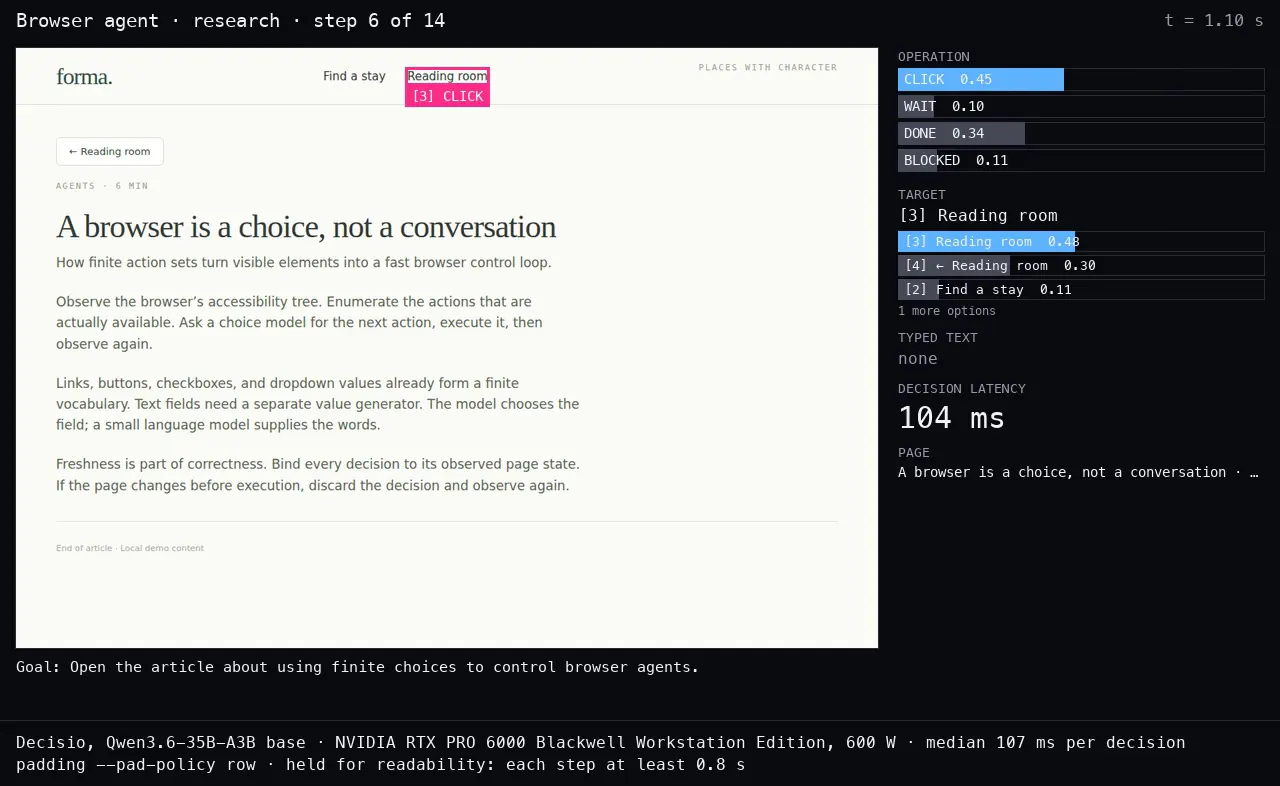
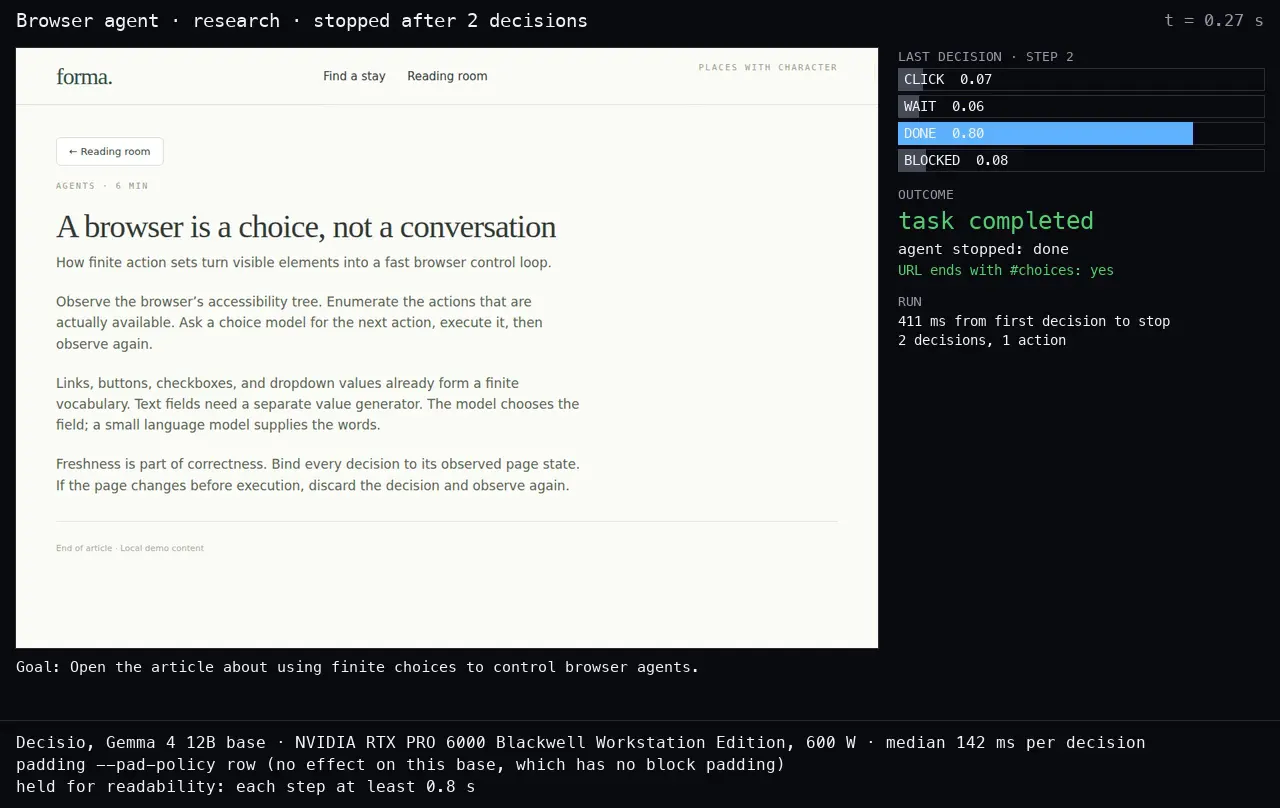
First frame of the recorded run: Browser agent, the reading room: Qwen3.6-35B-A3B base
Browser agent, the reading room: Qwen3.6-35B-A3B base
First frame of the recorded run: Browser agent, the reading room: Gemma 4 12B base
Browser agent, the reading room: Gemma 4 12B base
First frame of the recorded run: Browser agent, the reading room: Gemma 4 31B base
Browser agent, the reading room: Gemma 4 31B base

Browser agent

Every step is checked against the actions a careful user could take on two fixture tasks.

  • 10 of 10runs completed on each task
  • 91%of 272 labelled steps inside the acceptable set (248)
  • 184 msper decision, median (95th percentile 417 ms)

Gemma 4 31B, decisio v0.6.0, 2026-10-05

Every base 3 bases
Browser agent (10 runs of each task)
playertravel completedtravel decisions rightreading room completedreading room decisions rightlatency p50 / p95
Decisio, Qwen3.6-35B-A3B base10/1050/7010/1080/140141 / 174
Decisio, Gemma 4 12B base10/1060/6010/1020/20141 / 275
Decisio, Gemma 4 31B base10/1040/5010/1020/20184 / 417

On the 272 labelled steps (the operation question alone), the answer is inside the acceptable set on 243 (89%) for the Qwen base, 269 (99%) for Gemma 4 12B and 248 (91%) for Gemma 4 31B.

Where it was wrong
Browser agent: decisio's errors, by kind
demobasedecisions judgedagreelatencyprompt or statenear-tiejudgementwhat the errors are
browser, labelled stepsQwen3.6-35B-A3B2722430 by construction5420DONE before the search is applied; a click on the wrong control
Gemma 4 12B2722690 by construction012
Gemma 4 31B2722480 by construction1707mostly DONE while a typed search is still unsubmitted

In the live browser runs every base completes both tasks every time, but not always by the shortest path. On the travel task the Qwen base re-selects the category once and opens Casa Flora before submitting the typed destination, and Gemma 4 31B opens Casa Flora without submitting it; the fixture's own check does not test the search, so the runs count as completed and the oracle counts those steps as misses.

In the reading room the Qwen base opens the article and then clicks back to the list about six times (its probability for DONE on the article is 0.27 to 0.42) before DONE wins. Gemma 4 12B takes the shortest path in both tasks in every run, and Gemma 4 31B in the reading room.

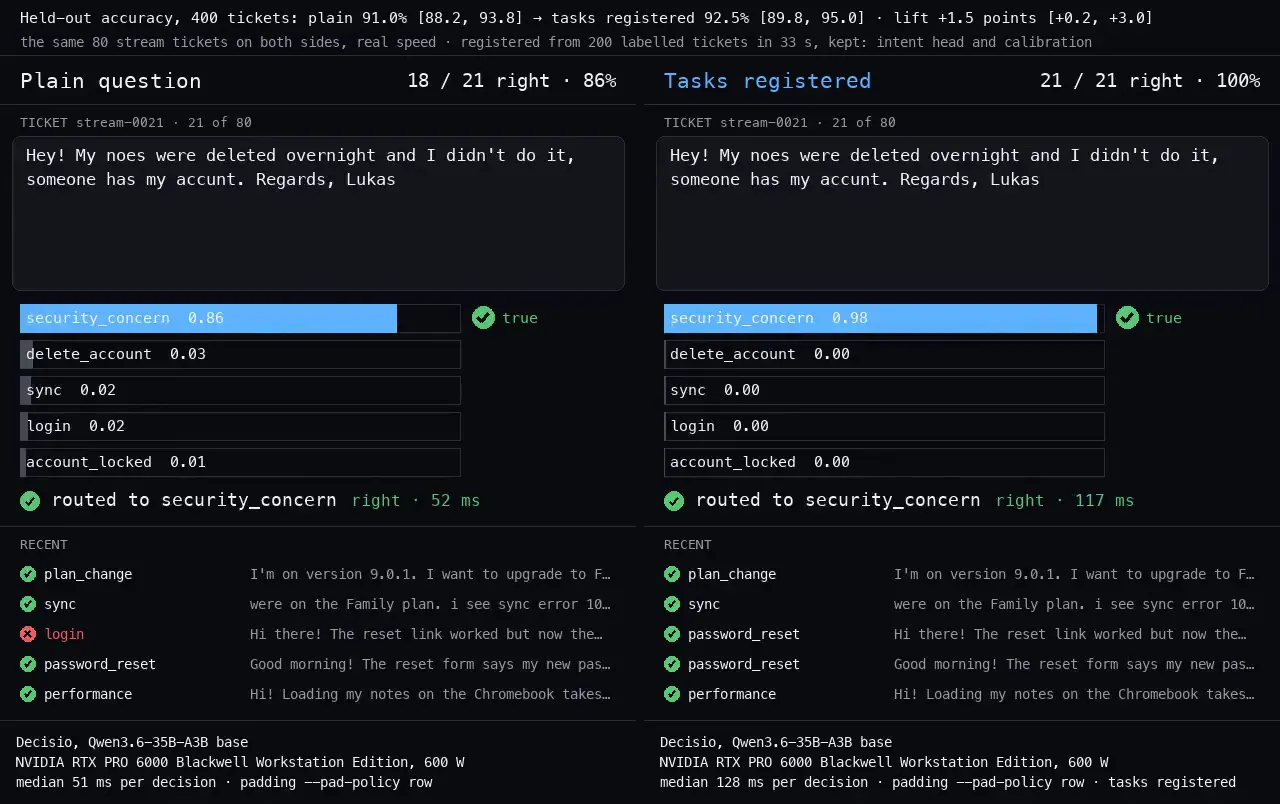
First frame of the recorded run: Triage, the same tickets before and after registering 200 labelled tickets: Qwen3.6-35B-A3B base
Triage, the same tickets before and after registering 200 labelled tickets: Qwen3.6-35B-A3B base
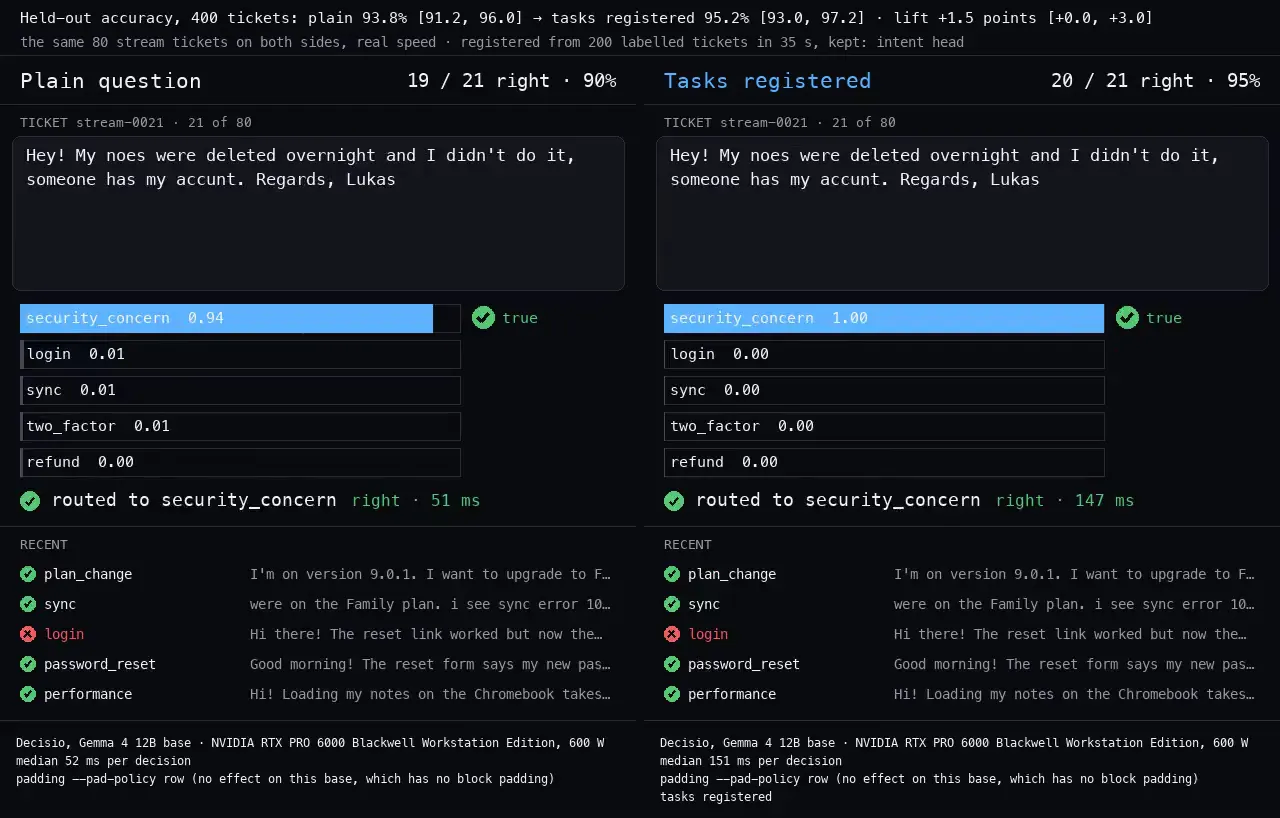
First frame of the recorded run: Triage, the same tickets before and after registering 200 labelled tickets: Gemma 4 12B base
Triage, the same tickets before and after registering 200 labelled tickets: Gemma 4 12B base
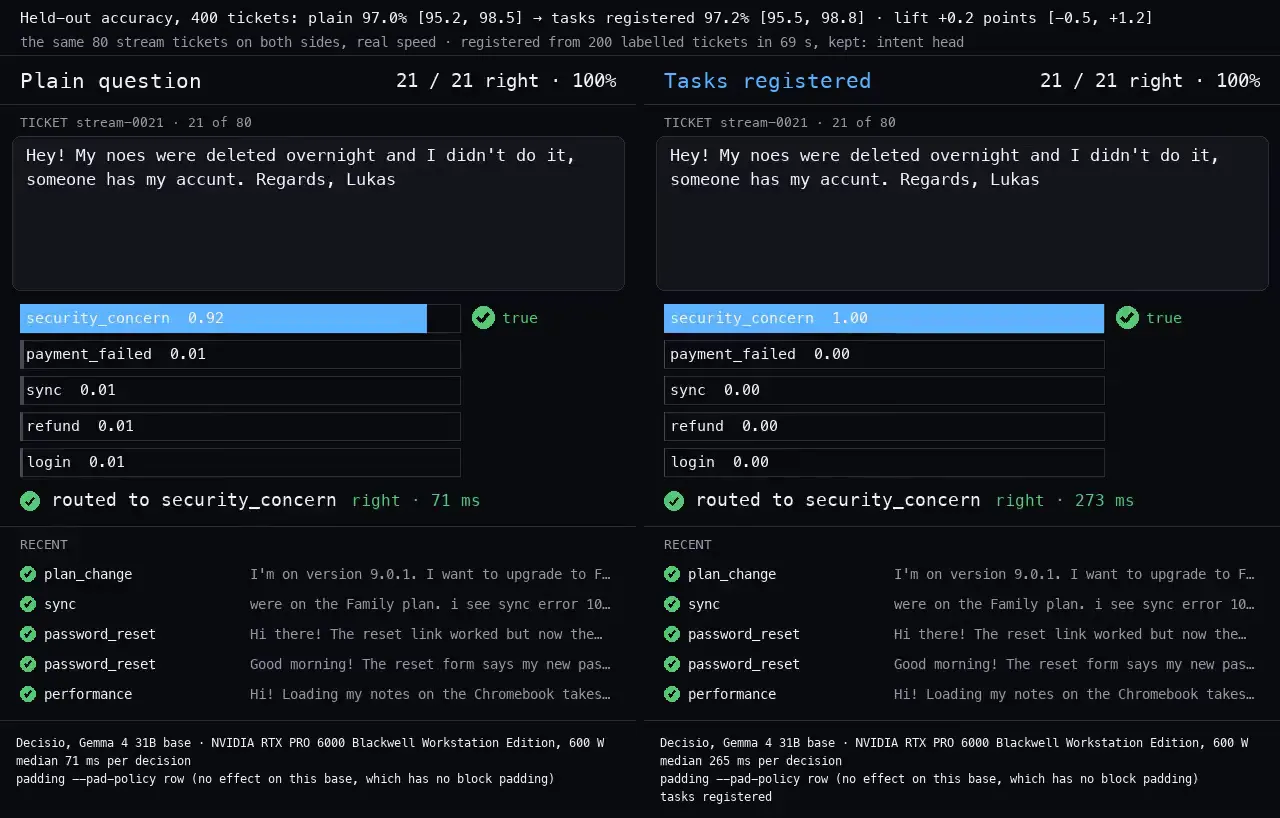
First frame of the recorded run: Triage, the same tickets before and after registering 200 labelled tickets: Gemma 4 31B base
Triage, the same tickets before and after registering 200 labelled tickets: Gemma 4 31B base

Triage

Every ticket's queue is checked against its true queue, before and after teaching it 200 labelled tickets.

  • 97.0%of 400 tickets routed right over 20 queues, with no teaching (95% interval 95.2 to 98.5)
  • 97.2%after teaching it 200 labelled tickets: +0.2 points (95% interval -0.5 to +1.2)
  • 69 sto teach it the 200 tickets

Gemma 4 31B, decisio v0.6.0, 2026-10-05

Every base 3 bases
Triage (400 held-out tickets over 20 queues)
baseplain questionafter registering 200 labelled ticketspaired differencemacro-F1, plain / registeredlatency p50, plain / registered
Qwen3.6-35B-A3B91.0% [88.2, 93.8]92.5% [89.8, 95.0]+1.5 points [+0.2, +3.0]; 7 answers fixed, 1 broken0.912 / 0.92642 / 120
Gemma 4 12B93.8% [91.2, 96.0]95.2% [93.0, 97.2]+1.5 points [+0.0, +3.0]; 8 fixed, 2 broken0.938 / 0.95250 / 145
Gemma 4 31B97.0% [95.2, 98.5]97.2% [95.5, 98.8]+0.2 points [-0.5, +1.2]; 2 fixed, 1 broken0.970 / 0.97371 / 262

Registration was repeated on each base and took 33 s, 35 s and 69 s.

Method

How the demos were judged

Every decision was checked against an oracle, a judge that knows the right answer, with the same seeds, oracles and renderings for every base.

How each demo's decisions are judged
demothe oraclewhat it is not
Ponga perfect-information paddle: the true ball's crossing of the paddle's plane after wall bounces, and a move toward it, staying inside half a step (6 units)while the ball moves away there is nothing to judge; those decisions are counted apart
drivingthe demo's own rules driver on the same snapshot and the same candidates: the motion (drive or stop) and the manoeuvrea good driver, not a perfect one; the drive's own score (arrive with no collision, red light, rolled stop sign, failure to yield or a second off the road) is reported beside it
browser agentthe set of actions a careful user could take at each step of two fixture tasks; 272 labelled steps from three placesa label for the operation and the target on two small fixtures
triagethe ticket's true queuesynthetic, templated tickets

How a miss is classed, in this order

  1. Latency effect: the right decision arrived too late (driving only: the answer equals the oracle on the snapshot it was asked about but not when it was applied, or the demo's 1.5 s timeout replaced it).
  2. Prompt or state effect: a written detector per demo, defined before any fix was tested: the model followed the question's own wording where it differs from the oracle (Pong's 5-unit band against the game's 6; the driving state's "at" a light up to 6 m before the line, where the rules driver stops within 1.5 m, counted "as worded" and not as an error), or the state lacked what the decision needs (the browser agent: DONE while a typed search is still unsubmitted).
  3. Near-tie: the chosen option's probability minus the oracle option's is below 0.10.
  4. Judgement error: anything else; reported, not tuned away.

Run them yourself: the demos in decisio's examples, at v0.35.0.